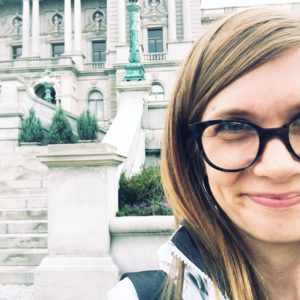
Lauren Pressley is the Senior Associate Dean for Research and Learning Services for the University of Washington Libraries. In this role she is responsible for strategic visioning, policy and program development, management, and overall excellence in Access Services, Assessment and Planning, Communication, Facilities and Events, Information Technology Services and Digital Strategies, Learning Services, Research Services, and Scholarly Communication and Publishing.
Prior to serving in this role, Lauren was an Associate Dean of the University of Washington Libraries and Director of the UW Tacoma campus library. Before joining the University of Washington Libraries, Lauren was Director of Learning Environments for Virginia Tech University Libraries and held a number of roles related to instruction and technology at Wake Forest University’s Z. Smith Reynolds Library.
Lauren regularly publishes and presents on leadership, organizational change, the evolving information environment, and the future of libraries. She has served in several leadership positions within the American Library Association (ALA), the Association of College and Research Libraries (ACRL), the Library Information Technology Association (LITA), and the Horizon Project. She is a current participant in the Association of Research Libraries Leadership Fellows program.
Lauren is a past president (2018-2019) of the Association of College and Research Libraries, the higher education association for academic libraries and library workers, representing more than 10,000 individuals and libraries. Her President’s Program was focused on organizational change in support of equity, diversity, and inclusion.
Lauren has been recognized with the Bea Kovacs Outstanding Alumni Award from the UNC-Greensboro Library and Information Studies Program, with a Distinguished Alumni Early Career Award from the UNC-Greensboro School of Education, and as an ALA Emerging Leader. Lauren is an alumna of the UCLA Senior Fellows program and holds MLIS from the University of North Carolina—Greensboro and Bachelor of Arts degrees from North Carolina State University in Small Group and Interpersonal Communication and Philosophy.
On the web:
In the physical world:
- Email: pressley@uw.edu
- Phone: 206-543-1832
- Mailing: Box 352900, University of Washington, Seattle, WA 98195
Let’s connect: